June 22, 2026
Of my Father
by Pastor Josh Czinger
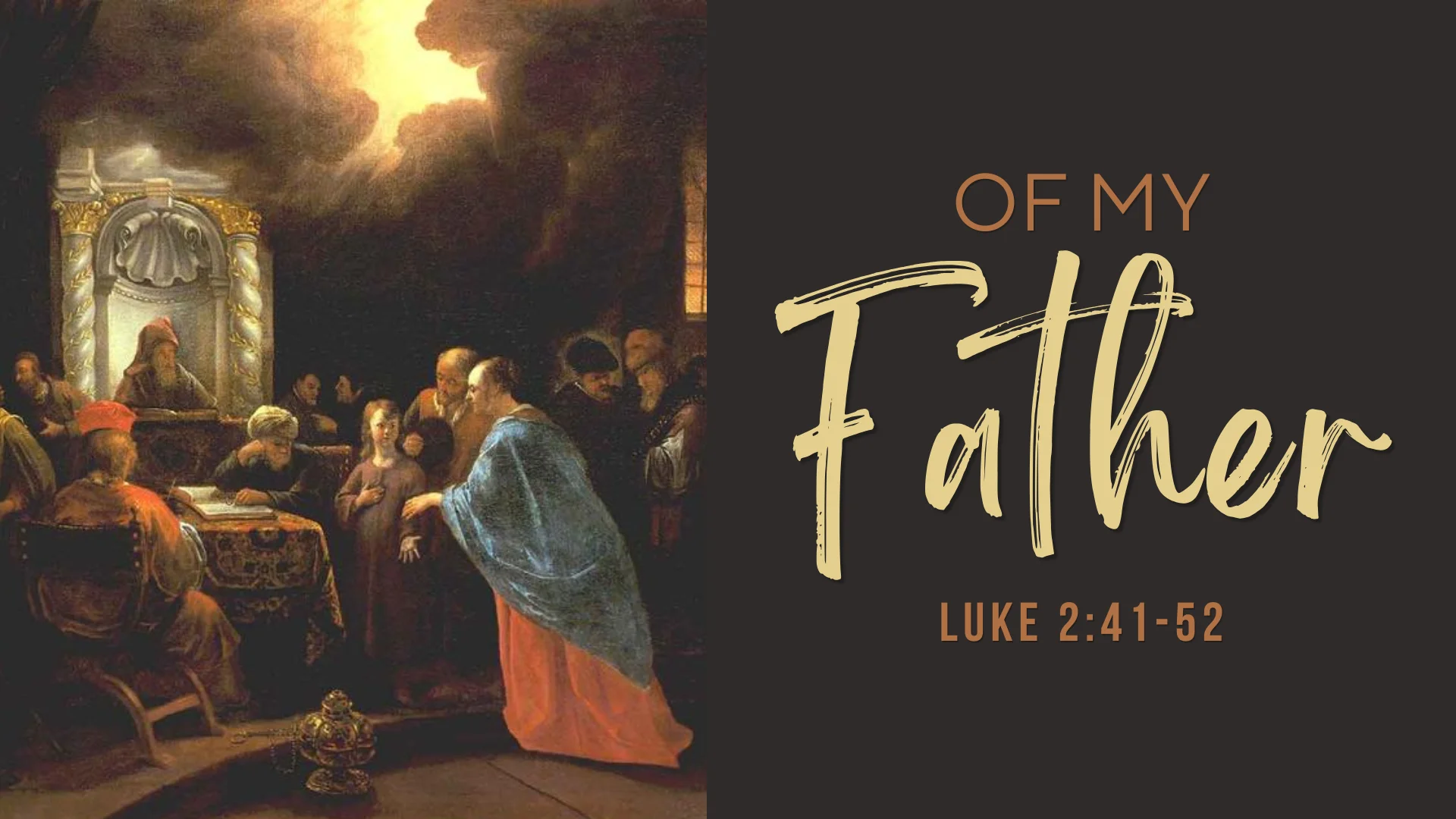
Luke gives us one of the only windows we have into the part of Jesus’ life over which we often skip. We are good at thinking about Jesus as a baby, and we are good at thinking about Jesus in public ministry, teaching, healing, suffering, dying, rising. But we tend to rush right past the long middle. The growing up years. The ordinary years. The hidden years. And that is strange, because that is where we live too. We live in the middle. We live in the growing up. We live in the place between not knowing and thinking we know, and then realizing we do not know nearly as much as we thought.
In Luke 2, Jesus is twelve years old, right on the edge of adulthood in Jewish life, right on the cusp of accountability, right at that moment where a family and a community would begin to watch closely and ask what kind of man this boy is becoming. Joseph and Mary go up to Jerusalem for Passover, and on the way home they realize Jesus is not with them. They spend a day traveling, a day coming back, and a day searching. Three days without him. That is not mild parental concern. That is grief. Agony. They thought they had lost him. Maybe worse. Then they find him in the temple, sitting among the teachers, listening, asking questions, and answering in a way that leaves people astonished.
When Mary asks why he has done this to them, Jesus gives a remarkable answer: did you not know that I must be in the … of my Father?
That is the strange part. The phrase is left open. Translators usually fill it in with “my Father’s house” or “my Father’s business,” and both are faithful attempts to carry the meaning. But the Greek leaves a blank there. A kind of ellipse. Three little dots, as it were. Something is there, and yet it is left for us to enter.
It is not a mistake; it is an invitation.
We can think of this elipse as “my Father’s house.” That fits the scene because Jesus is in the temple. He is where the presence of God is sought, where scripture is discussed, where people gather to learn and worship. There is something deeply innocent and deeply profound in the way Jesus responds. Why were you looking for me? This is where I am supposed to be. And for us, that lands plainly. We need to be in the presence of God. We need to be with the people of God. We need spaces where the noise gets pushed aside and our souls can pay attention again. We need to be in the Father’s house.
We can think of this elipse as “my Father’s business.” Jesus is engaging in sacred purpose. He is listening, asking, answering, drawing near to people who want to know God. Not with swagger. Not with hierarchy. Not performing. Just present, attentive, about what the Father is about. That matters. The Father’s business is always drawing people close. Always preparing something bigger than we can see. We do not always know what faithfulness will produce twenty years from now. We usually do not. But that does not make the faithfulness small. It just makes it seed.
Maybe the best way to hear the verse is to leave the blank open. I must be of my Father. Everything of my Father. House, business, presence, purpose, identity, desire, calling. Everything. Deuteronomy says to love God with all your heart, soul, and might (מְאֹד). That last word carries the sense of your muchness, your everything, all you have, all you are, all you can bring to bear. That is what belongs in the blank. Everything.
That gets uncomfortable fast, because we would prefer manageable religion. A little Sunday. A little church attendance. A little moral cleanup. But the ellipse will not let us stay there. What belongs there is not a sliver of your life. It is your life. Your attention. Your relationships. Your work. Your body. Your mind. Your resources. Your worship. Your questions. Your future. All of it. Of my Father.
There is one more thing here that matters. Joseph brought Mary and Jesus to Jerusalem even though they were not required to come. It cost him something. Travel, money, safety, effort, inconvenience. He could have gone alone. He could have left them behind. He did not. He prioritized the things of God, and that shaped Jesus in his human life in ways Luke quietly lets us see. Jesus grew in wisdom and maturity and in favor with God and people. Joseph’s example mattered. What you repeatedly bring your family toward matters.
So the question is not complicated, even if it is difficult. What are you putting in the ellipse? What belongs in that blank space when you say, I must be of my Father?
It has to be everything. Not perfectly. Not painlessly. But truthfully. Everything.
What are you still holding back that needs to go into the Father’s hands? What are you still about that you no longer need to be about? What would it look like for your life, really, to be in the … of your Father?